
By Philip Speck, 123rd Airlift Wing
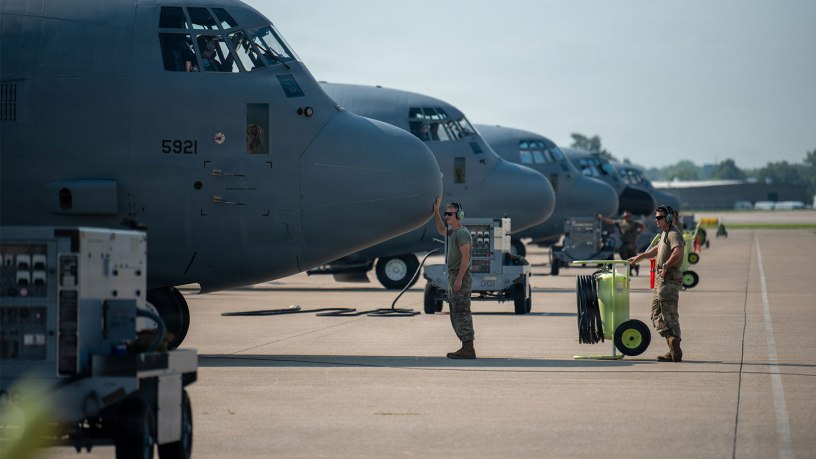
Aircrews from multiple C-130 units across the Air National Guard and active-duty Air Force gathered here in August for the third-annual C-130 Air Reserve Component Fly-In and Rodeo.
The event, staged at the Kentucky Air National Guard Base by the 165th Airlift Squadron, drew participants from the active-duty 41st Airlift Squadron, the Air National Guard Air Force Reserve Command Test Center, and Air Guard units in Montana, Delaware and Texas, said Col. Josh Ketterer, commander of the Kentucky Guard’s 123rd Operations Group. Crews from the Illinois Air National Guard also attended the event as observers.
A mix of C-130H Hercules and C-130J Super Hercules aircraft participated, with Montana and Delaware flying the legacy H-model and other participants operating J-models.
The rodeo was modeled on the Weapons and Tactics Conference, a fly-in designed to bring C-130 units together to complete training requirements that are difficult to accomplish at home station, Ketterer said.
“This event fulfills combat mission readiness requirements and maintains proficiency in challenging core competencies, including large formations and joint operations with airborne forces,” he said.
Participants received briefings from subject matter experts and reviewed current threats and tactics before executing joint mission planning.
The first event of the week was a mission to Fort Campbell, Kentucky, where crews supported an airdrop for the 101st Airborne Division and 160th Special Operations Aviation Regiment. Threat emitters were integrated into the scenario to replicate a realistic contested environment.
The week finished with a “rodeo,” a single-crew competition that tested proficiency across several skills, Ketterer said. Crews were scored on timed cargo upload and combat offload, time on target, airdrop accuracy, threat reaction, time of arrival at the landing zone, assault landing and single-point fuel offload.
The multi-event format was designed to touch every major component of the tactical airlift mission.
“Our rodeo brings together elements across the entire mission set that we can we can quantify, collect data on and compete against one another with,” said Capt. Samuel Williams, an instructor pilot with the 165th Airlift Squadron. “The rodeo itself is meant to be a morale-building event bringing crews together across the C-130 community.
“It would not possible without the agency support we receive from our maintenance teams, aerial port, aircrew flight equipment and airfield management,” he added.
“We all work very hard to train and be the best we can be when the time comes to serve our country. This type of event validates that training for our crews, and gives us the opportunity to put our skills to the test.”
“Training like this is very important for us,” noted Senior Airman Andrew Hudson, a loadmaster with the 165th Airlift Squadron. “Having a competition between other wings gives the low-consequence pressure of trying to be first, and it helps you self-identify how you and your crew work under pressure to achieve a specific goal.”
Ketterer said that kind of focus on team-building is essential for unit effectiveness and global engagement.
“Continually improving and ensuring our interoperability within the C-130 community is critical for both our federal and domestic missions, ” he said.

