
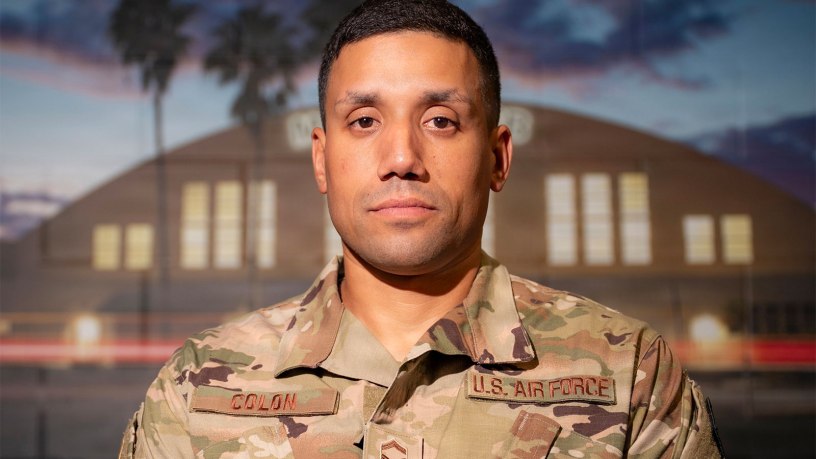
By Tech. Sgt. Bradley Tipton, 927th Air Refueling Wing
Police body camera footage plays like an action film: choking gray smoke pours from a crushed dashboard, orange flames scattering light through shattered glass partially illuminate the chaotic scene as a pair of gloved hands lunge straight into the cabin, cut the seat belt and drag an unconscious driver to safety seconds before the entire vehicle is consumed by fire.
Behind the lens was Air Force Reserve Senior Master Sgt. Luis Colon.
To the citizens of Sarasota, Florida, he is a dedicated police officer protecting the streets. To the Airmen of the 927th Air Refueling Wing at MacDill Air Force Base, Florida, he is an experienced defender serving as operations superintendent of the 927th Security Forces Squadron.
On June 30, 2025, both worlds collided in a test of nerve and muscle memory.
Colon and a probationary officer were arresting a suspect when the sound of an out-of-control vehicle, estimated to be traveling at more than 100 mph, colliding with a light pole in the distance interrupted what they thought would be a routine night on duty.
After securing their suspect, Colon and his trainee sprinted to the crash site. The impact had crumpled the vehicle and trapped the sole occupant as fire took hold in the engine bay.
“She was breathing but completely unresponsive,” Colon recalled. “When I heard the sound, I knew they had been going at a high rate of speed. At first, I didn’t think, I just took action.”
As thick smoke filled the cabin and heat radiated against his face, Colon faced a series of quick decisions. His training kicked in automatically.
“I detached emotionally and went straight into the OODA loop to maintain situational awareness,” Colon said, referring to the military decision-making model: observe, orient, decide and act. “By the time we got her out of the car, the steering wheel had already caught on fire. As we dragged her away, I could see the flames were already progressing toward the back of the car.”
The decision to place himself in danger, cut the seat belt and drag the driver away from the inferno happened in seconds. Any delay could have been fatal.
For Colon, high-stakes emergencies are not rare, and his decisions are not haphazard. They are the product of a dual career built around crisis management. Daily work in civilian law enforcement, paired with experience in rapid response and austere base defense as a security forces defender, helps form instincts for the worst moments.
“On any given shift on the street, anything can happen in milliseconds,” Colon said. “The ability to process chaos, prioritize life-saving actions and execute under pressure is something you live every single day.”
Colon is quick to note that the ability to act under pressure is not unique to security personnel. He pointed to the Air Force Reserve’s emphasis on combat-readiness programs such as Tactical Combat Casualty Care. Those standardized skills are designed so every airman — regardless of Air Force Specialty Code — can provide critical medical intervention and leadership in unpredictable, contested environments.
“It doesn’t matter what career field you’re in; we are all going to be doing something that could potentially be dangerous,” Colon said. “If you’re in a military uniform, you’re the first person people are going to look to when they need help.”
Despite public attention on the rescue, Colon deflects the spotlight and instead emphasizes a broader call for anyone in uniform: remain ready.
“Other officers do more and have been in way worse situations,” Colon said. “I don’t expect everyone to do what I did, but I hope you would try to do something to help.”
For leaders at the 927th Air Refueling Wing, Colon’s actions represent the warrior ethos.
“When seconds mattered and a life was on the line, Senior Master Sgt. Colon didn’t hesitate,” said Col. John Weeks, 927th Mission Support Group commander. “We are incredibly proud of his heroism, but those of us who serve alongside him are not surprised. ‘Service Before Self’ is in his DNA, whether he’s wearing a police badge or a Security Forces beret.”

