
Courtesy Story, U.S. Army Combined Arms Command
FORT LEAVENWORTH, Kan.— The U.S. Army’s Combined Arms Command (CAC) is spearheading a sweeping overhaul of its educational framework, ensuring that soldiers, from new recruits to senior officers, are equipped with both the foundational warfighting skills and the technological acuity needed for future conflicts.
Under the leadership of Lt. Gen. James P. Isenhower III, the commanding general of CAC, the command is embedding lessons from global hotspots and emerging technologies directly into its curriculum. This effort is designed to produce soldiers who can master basic processes and critically employ advanced tools like artificial intelligence.
A cornerstone of this transformation is the structural consolidation of the Army’s educational institutions. The five premier Army colleges, including the Army War College and the Command and General Staff College, now operate under a unified Army University. This structure, along with the alignment of the Army’s 10 Centers of Excellence under CAC, allows for a synchronized approach to training and education across the entire force.
“We are teaching the basic analog processes to a level where we’ve got proficiency that enables that soldier—that student—to then question with confidence the product they get from AI,” Isenhower stated during a recent media roundtable.
This “analog-first” philosophy is central to CAC’s strategy for technology integration. At institutions like the Command and General Staff College, AI is being gradually introduced into staff and decision-making exercises. However, the command insists that students must first master the traditional, hands-on processes. This ensures that a soldier can identify when an AI-generated solution is flawed and make the correct human decision, rather than blindly trusting the technology.
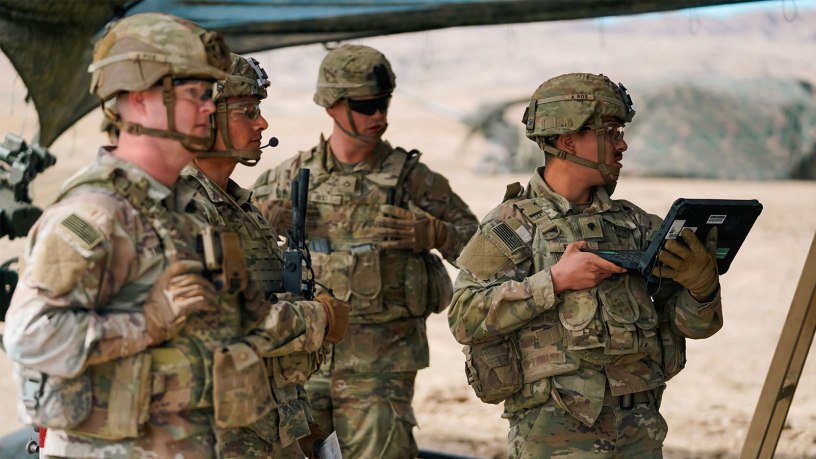
The curriculum updates extend to the earliest stages of a soldier’s career. Recruits in Basic Training are now introduced to the threat of unmanned aerial systems (UAS) and are taught the corresponding battle drills for survival on a transparent battlefield.
“Hiding in plain sight has become an imperative on the modern battlefield, and frankly, it’s a sea change in how our army considers its own protection efforts,” Isenhower explained, noting that skills like dispersal and camouflage are being re-emphasized.
Furthermore, CAC is working to eliminate the learning curve for soldiers arriving at operational units. Data analysis platforms like Maven Smart Systems and Vantage, which are used by corps and theater armies, are now being integrated into schoolhouse courses.
“Soldiers need to know how to use that,” Isenhower said. “So when they [arrive], it’s not a learning requirement for them… they can fall in on what’s already being used in the operational force and immediately contribute to mission accomplishment.”
This rapid evolution of doctrine and training is fueled by a dynamic feedback loop. Transformation Lessons Learned Managers (TLLMs) are deployed to exercises and operational theaters to collect observations. These insights are quickly analyzed and disseminated, often first as non-prescriptive Army Techniques Publications (ATPs), allowing the force to adapt at a pace that matches the speed of modern warfare.
Ultimately, the command’s educational philosophy balances a “back to basics” mandate with a progressive modernization approach. According to Isenhower, the two are not mutually exclusive.
“If a soldier doesn’t have confidence in a piece of equipment, he’ll discard it,” he said. “We always must be brilliant at the basics, but that comes with a requirement to responsibly integrate technology to make sure that we’re providing soldiers with the best advantage we can provide them.”

