
By Staff Sgt. Serena Smith, 129th Rescue Wing
MOFFETT AIR NATIONAL GUARD BASE, Calif.— For a pilot forced down behind enemy lines, survival can depend on the equipment they carry with them.
Airmen from across the Air Force recently tested a new lightweight weapons accessory designed to give downed aircrew greater accuracy and control without adding significant weight to their already limited survival gear.
In April, an Airman from the California Air National Guard’s 129th Rescue Wing, and eight others from an Air Force Reserve fighter unit and Air National Guard units in Alabama and Hawai’i gathered at Joint Base Pearl Harbor-Hickam, Hawai’i, to test the Isolated Personnel Lethality Optimization, or IPLO, conversion kit.
The event brought together Airmen from several aircraft communities to determine whether the system could provide aircrew with a simple and effective option in a survival situation.
“The purpose of the IPLO proof of concept event was to get aviators from F-22, F-35 and HC-130J communities together, conduct a safe but minimal amount of training, put the weapon system through its paces and see how it performed,” said U.S. Air Force Lt. Col. Niul Manske, commander of the 131st Rescue Squadron and chairman of the 2025 Air Reserve Component Weapons and Tactics Conference Isolated Personnel Working Group.
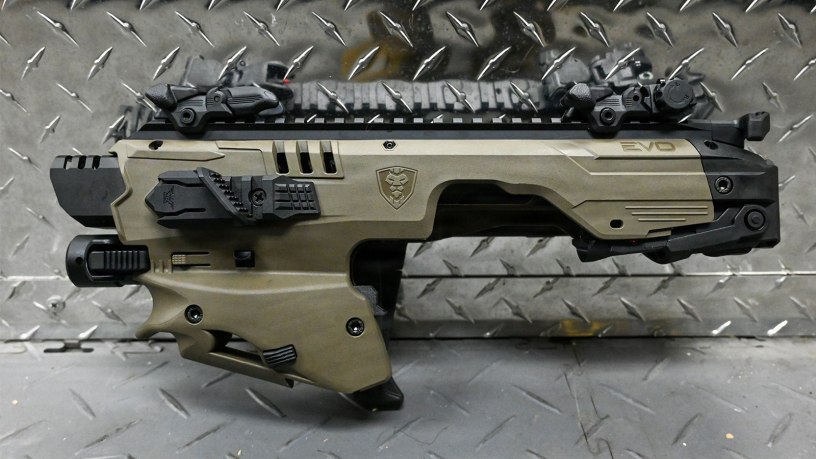
Aircrew have limited space for survival equipment, making the size and weight of anything added to their kits an important consideration. The IPLO was developed as a lightweight, low-cost accessory that can be quickly paired with the standard-issue M18 pistol.
To use the IPLO, an Airman slides the M18 into a slot on top of the conversion kit, securing the pistol within the system. Once attached, the IPLO provides four points of contact, giving the user greater stability and control than the pistol alone. The result combines rifle-like handling with the practical range of a pistol while remaining compact enough to fit inside an aircrew survival kit.
After arriving at the event, the nine Airmen received a short training session before testing the system themselves.
“It’s very simple for people to employ without much training at all and increases accuracy at a further range,” said Maj. Cole Temmen, a combat systems officer with the 130th Rescue Squadron at the 129th Rescue Wing.
Temmen, who had never used a similar accessory before the event, said the system’s simplicity could make it particularly useful for aircrew who have little room to spare in their survival kits.
At an indoor shooting range, the Airmen compared their accuracy under varying levels of stress, comparing their performance with and without the IPLO.
The results verified that the IPLO increased accuracy up to 50 percent and speed up to 60 percent, making for a more lethal fighter, Manske said.
“[Aircrew] that have limited space and capacity can put this in their seat kit and it easily folds out and attaches in a moment’s notice,” Temmen said. “It puts the warfighter in a better position.”
The project brought together the 129th Rescue Wing, ARCWERX, the Air National Guard Air Force Reserve Test Center and the Air Reserve Component Weapons and Tactics Conference Isolated Personnel Working Group. Their collaboration moved the IPLO from an idea to operational use in less than 160 days.
For Temmen, the potential benefit comes down to giving aircrew another option when they find themselves in one of aviation’s most dangerous situations.
The system requires little additional training and adds minimal weight to an aircrew member’s survival equipment, he said.
If adopted more broadly, the IPLO could provide Air Force aircrew with a compact addition to their survival kits designed to improve their ability to protect themselves while awaiting rescue.

