
By Petty Officer 2nd Class Connor Burns, U.S. Naval War College
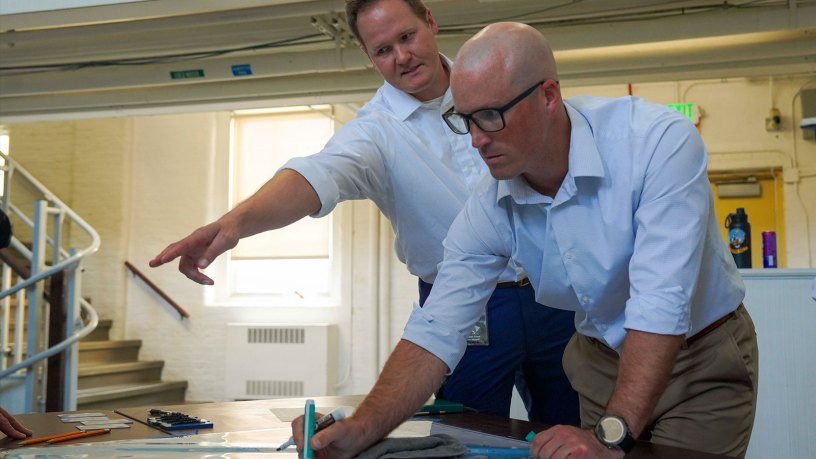
NEWPORT, R.I.—The U.S. Naval War College (NWC) hosted a war game re-enacting the Battle of Jutland onboard Naval Station Newport, Sep. 9, that involved descendants from U.S. and German forces involved in World War I.
The Battle of Jutland was fought between the Royal Navy and Imperial German Navy off the North Sea coast of Denmark’s Jutland Peninsula from May 31 to June 1, 1916, and was the largest naval battle of the first world war, concluding with both Britain and Germany claiming victory – Germany for sinking more ships, and Britain for maintaining control over the North Sea, contributing to the ongoing blockade of Germany.
Then-Rear Adm. William S. Sims, U.S. Navy, recognized the implications of the battle and used an official report sent directly to him by his friend, Royal Navy Adm. John Jellicoe, commander of the Grand Fleet, to launch reconstructions of the battle on the NWC wargaming floor. Sims then used the insights from those wargames to defend Jellicoe’s choices to the U.S. Congress in December of 1916, highlighting the strategic importance of the battle.
Sims went on to be appointed as the 15th president of NWC in February of 1917, but was relieved in April of that year to assume command over the U.S. naval forces operating from Great Britain once the U.S. entered the war. After World War I, Sims returned to his post as president of the war college from 1919-1922.
“Taking an applied approach to studies in history stood out as being among the most important functions that Admiral William S. Sims emphasized as the President of the Naval War College before the U.S. Navy formally became involved in the First World War over a century ago,” said Capt. T.B. Kittredge Historian and College of Maritime Operational Warfare Prof. David Kohnen, Ph.D. “His essay, ‘Cheer Up!! There is No Naval War College’ and then his ‘Practical Character of the Naval War College’ emphasized the vital importance of historical analysis for naval thinkers to understand the contemporary challenges inherent with ongoing technological innovation and in overcoming the unforeseeable strategic surprises of the future.
“By using history as the basis for sparking inspired professional debate in the classroom settings of the Naval War College after the First World War, Admiral Sims also educated what I like to call the ‘five-star thinkers’ of the Second World War,” he continued.“Sims remained an active contributor to the Naval War College curriculum after his retirement in the 1920s and he kept an office near the Mahan Rotunda at the Naval War College until his death in 1936.”
One hundred and 10 years after the Battle of Jutland, Sims’ grandson, Dr. Nat Sims, was invited to take part in the execution of his grandfather’s wargame inside of his namesake building – Sims Hall.
“It’s both very real and very surreal to be here, I’m outside of myself trying to process not just my grandfather, but all the other great historical figures who walked on these floors,” Sims said. “I was very excited to be [at the wargame]. I was here for the hundredth anniversary of the Battle of Jutland in this building in 2016. At the time, I didn’t understand how important that battle was, but being here helped me understand that in real time.”
The 2026 Battle of Jutland wargame involved approximately 15 NWC students and faculty.
U.S. Army Lt. Col. Ian Ahearn was among the students involved, playing a part in the Royal Navy team of the wargame.
“Being part of a Navy wargame like this lets me understand how the other parts [of the military] think, how they do things,” Ahearn said. “The instructors are great with explaining things, and exercises like these make it easier to visualize how the Navy operates.”
There were also numerous observers to the wargame from NWC’s International Programs Department.
Lt. j.g. Fabian Felder, German Navy, was among these observers.
Felder’s great-grandfather served as a deck officer aboard the battle cruiser SMS Von der Tann during the Battle of Jutland. The Jutland Wargame was studied by military leaders such as Fleet Adm. Chester W. Nimitz, Ernest J. King, and William F. Halsey during their tenures at NWC.
Today’s version of the wargame implements replicas of the models and game pieces used 110 years ago.
Established in 1884, NWC informs today’s decision-makers and educates tomorrow’s leaders by providing educational experiences and learning opportunities that develop their ability to hedge aggressively, innovate continuously, fight distributively, delegate confidently, and command with clarity within complex battlespaces.

