
By Shane Hughes, 178th Wing
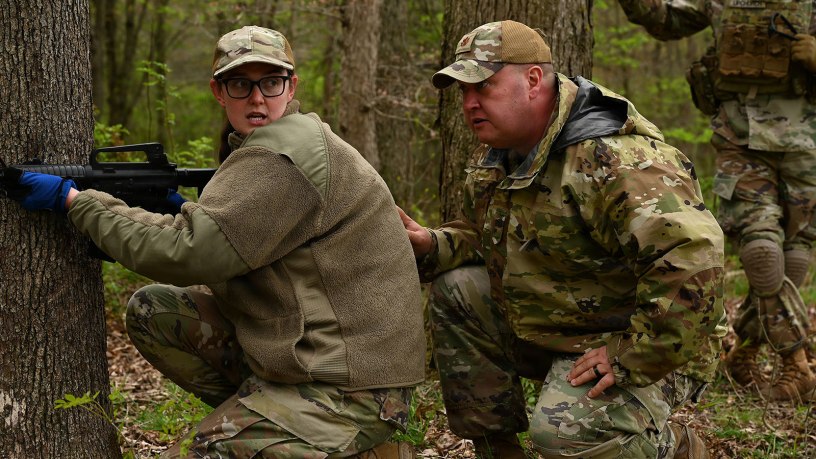
Air Force Tech. Sgt. Stephanie Wilburn crept through the woods with an M4 rifle tight to her shoulder, alert to her surroundings and scanning the trees and brush for any signs of an enemy threat. Close behind her, Maj. Billy Newman, a chaplain assigned to the 178th Wing, followed along, unarmed, with only his faith and his chaplain assistant to protect him. Somewhere in the woods, there was a wounded airman who needed their help.
The sound of gunfire broke the silence. Wilburn instantly took cover behind the nearest tree. “Get down, get down!” she shouted to Newman as she searched the area for the source of the threat. The two moved through the woods, Wilburn leading the way and shouting out combat maneuver commands as they searched for their objective under simulated fire. They located the wounded airman, and Newman crawled forward, pressing himself into the dirt to maintain a low profile. He applied a tourniquet before an Army instructor nearby called an end to the drill and complimented them both on their teamwork and communication.
Five members of the 178th Wing’s religious support team, including chaplains and religious affairs airmen from Springfield, Ohio, traveled to Camp James A. Garfield Joint Military Training Center to prepare for large-scale combat operations. They spent the two-day exercise training alongside counterparts from the Ohio Army National Guard, the Serbian Armed Forces and the Ohio Military Reserve. The weekend training began Saturday, April 25, and concluded the next day.
The training focused on land navigation, map reading, combat maneuvers, and finding cover and concealment so the chaplains and their religious support teams can navigate terrain in the event they become separated from their unit, survive contact with an enemy, provide life-saving medical care in the field, and return home safe.
Army Lt. Col. David Dietz, a chaplain assigned to the Special Troops Command of the Ohio National Guard, said the training was intended to shift focus from how chaplains have provided support during counterinsurgency operations to a new strategic mindset of how the services they provide will change in the event of a large-scale combat operation.
“This is really the crawl phase,” said Army Lt. Col. Joe French, a chaplain assigned to the 174th Air Defense Artillery Brigade. “We’re getting everybody ingrained to the basic soldiering skills, because you’re going to be out in the foxholes with your service members.”
The training also focused on the unique aspects of providing religious support to soldiers and airmen in complex and dangerous combat environments. They trained on how to provide “hasty” memorials for casualties of war when conditions require the unit to press forward. They learned how to provide prayer services and minister to deployed troops who may be experiencing grief and loss. They also practiced giving command talks, helping soldiers and airmen move forward after experiencing a large casualty event by giving them the hope and courage to continue fighting.
“It’s also about getting us to the basics of being a minister, too,” French said. “When you’re in a LSCO environment… you’ve got five minutes, so the word of God needs to be in your heart, your soul, your mind, and your strength, so that when you’re meeting that service member who’s maybe gone through the worst day of their life, you can bring them hope and re-instill the vigor to fight.”
“We need to be prepared for what our job is in that situation,” Dietz said. “We’re trying to get back to the basics.”
The training simulated field conditions that airmen and soldiers could expect to encounter during a large-scale conflict. Dietz said part of the purpose of the training was for the teams to get comfortable with being uncomfortable.
“As Air Force chaplains, we’re often at base camp, but here we get a chance to not only work with our Army counterparts but to be able to get out into the field and to be able to see what it’s like doing things in a combat environment,” Newman said.
For many of the soldiers and airmen participating in the training, it was their first time preparing for large-scale conflicts and working with their peers in other military branches.
“This is really the first time that our Air, our Army, and our (Ohio Military Reserve) have all been together in a field training environment,” French said. “We have different practices, and different focuses that each branch and each person brings together. So, if we can start merging those and getting ahead of what’s coming, we will be a full force.”
While everyone hopes these skills will never be needed, the chaplain corps of Ohio will be ready to serve those who serve, whether at home or abroad.

