
Story by Kevin Hymel, Arlington National Cemetery
“Do not worry, I am all right,” U.S. Army Air Forces Sgt. James “Jimmy” Murray wrote to his fiancée, Donna Young, after the Japanese bombed Clark Field, a U.S. base in the Philippines, on Dec. 8, 1941—one day after the attack on Pearl Harbor prompted the United States to enter World War II. Young never heard from him again.
Murray and Young were supposed to have married in October 1941. Two days before their planned wedding in Hollywood, California, the Army flew him to the Philippines to join the 93rd Bombardment Squadron at Clark Field. Soon after bombing the base, Japan invaded the Philippines. After months of intense fighting, American and Filipino forces surrendered on the Bataan peninsula on April 9, 1942.
Captured as a prisoner of war, Murray was forced to endure the infamous Bataan Death March, a 65-mile trek under harsh conditions to POW camps further north. He was eventually sent to Cabanatuan POW Camp #1, where more than 2,500 POWs perished from hunger and disease. Murray died on Jan. 7, 1943, at the age of 25, and was buried in the camp’s cemetery with three other deceased POWs.
Murray’s fiancée and his mother, Sarah Murray, never knew what happened to him beyond his name on a Red Cross list of American POWs who died of disease. Sarah was never able to bury her son. She would tell reporters that her son had always wanted to join the military; he was born at Fort D.A. Russell in Wyoming, where his father served as a lieutenant in the Army’s 83rd Field Artillery Regiment.
After the war, personnel from the American Graves Registration Service exhumed remains from the Cabanatuan camp’s cemetery and relocated them to an American mausoleum outside of Manila. In the process, they identified one of the soldiers buried with Murray. The other three, including Murray, were buried together as unknowns at the Manila American Cemetery and Memorial.
Murray remained unidentified until 2019, when members of the Defense POW/MIA Accounting Agency (DPAA) exhumed all three unknown soldiers as part of the Cabanatuan Project — an effort that began in 2014 to identify the 1,002 unknowns who had been buried in the camp cemetery. DPAA requested a DNA sample from Murray’s closest living relative, his cousin Jo Ann Hunter, who had never met him and was only five years old when he was captured. With Hunter’s DNA, they made a positive match.
Hunter, who grew up after the war, knew so little about her cousin that she believed he had been killed at Pearl Harbor. Although her aunt kept photographs of him, “she never talked about Jimmy,” Hunter recalled.
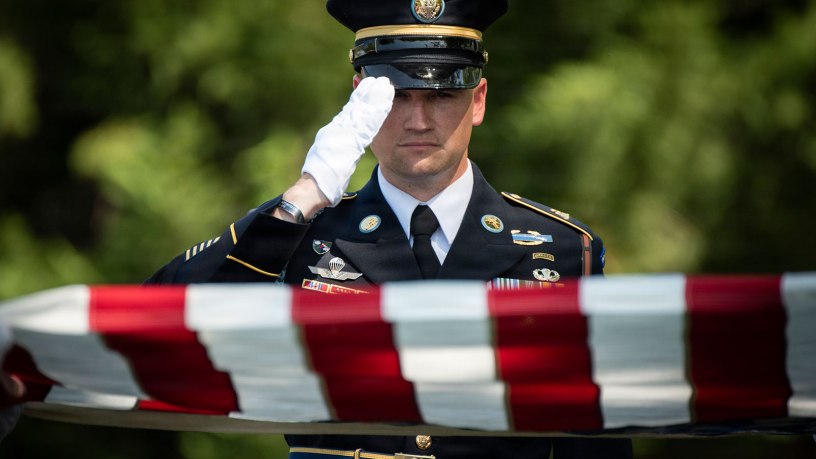
Hunter decided that Arlington National Cemetery would be the highest honor as her cousin’s final resting place. “When you think of the Army and service to the country,” she said, “you think of Arlington.”On April 15, 2026, Hunter, along with daughter Kim Cory and her family, came to Arlington for Murray’s funeral service. Several military and civilian members of DPAA also attended, all of whom had worked to identify Murray and return him home.
U.S. Army Chaplain (Capt.) Albert Addison, who provided the eulogy, noted that Murray had earned the Army Air Medal, the Bronze Star and the Purple Heart. Hunter wiped away tears as 1st Sgt. Ryan Mathes handed her the folded flag that had been draped over her cousin’s casket.
When the service ended, Hunter’s daughter showed the DPAA team a silver cup. Members of the 83rd Field Artillery, following an old Army tradition, had gifted the cup to Murray’s father to celebrate his son’s birth. “This represents a full circle,” she said, as she held the cup near her uncle’s casket.
Thanks to DPAA’s diligent efforts to identify the remains of those buried at Cabanatuan and many other sites around the world, former POW Sgt. Murray was finally home.

