
By Maddy Gonzalez, Fort Benning Public Affairs Office
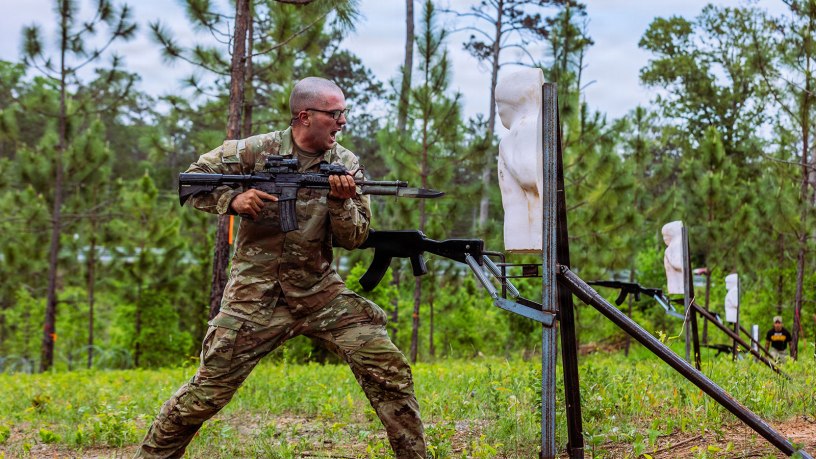
FORT BENNING, Ga. – The Army’s toughest course just got tougher. On April 21, 2026, the first class of U.S. Army Ranger students tackled Fort Benning’s new Bayonet Assault Course, a rugged addition to the Malvesti obstacle course. Integrated into the grueling Ranger Assessment Phase (RAP), the high-stress, obstacle-packed site provides a new way to assess a Soldier’s physical and tactical readiness at the very start of the course.
“The Bayonet Assault Course allows us to introduce a level of grit, a level of violence of action, very rapidly into Ranger school,” said Command Sgt. Maj. Patrick Hartung, command sergeant major of the Airborne and Ranger Training Brigade. “These are qualities they will carry with them as they go into the phases of the course.”
The course officially debuted during the Best Ranger Competition in April this year. The layout features modernized elements, including high-durability silicone targets, immersive smoke machines, walls, trenches and tunnels. Students must navigate the terrain and obstacles, closing with and attacking enemy bayonet targets before transitioning into the original Malvesti track.
Delivering this newly developed training site in time for the competition required support from across the entire installation. ARTB, the Fort Benning Directorate of Public Works (DPW), the Training Support Center (TSC), and supporting agencies joined forces to move the project from concept to completion in under a year, ensuring the site was fully mission-capable for the first day of the competition.
“From the time the project was awarded to completion was just two and a half months,” said Geoffrey Ray, DPW Operations and Maintenance Division Chief. “Considering we were working on undeveloped ground — doing all that clearing, lane marking, and digging — it was all hands on-deck.”
ARTB and DPW pooled resources, labor, and expertise to sustain the rapid construction pace and deliver the site ahead of schedule.
“We are here 100 percent to support the mission and the warfighter,” Ray said. “This enhancement just makes the Soldiers we’re training more lethal, more effective.”
While DPW crews shaped the terrain and built the structural obstacles, Fort Benning’s TSC fabrication shop manufactured the modernized bayonet targets. Adapting early-2000s blueprints, the TSC team engineered resilient silicone bodies capable of withstanding repeated impacts and weather. They also pioneered a completely new design for prone targets, constructing a specialized frame that enables highly realistic engagement.
“Originally, the prone targets were just the silicone body laid on the ground,” said William Walker, the TSC contract lead. “The fabrication shop was asked to devise a way to have it in place with a rifle attached, so we developed a frame that elevates the target, simulating a Soldier in a prone position.”
Walker noted that the facility’s ability to turn ideas into physical training aids isn’t limited to Fort Benning; it serves as an Army-wide asset available to any unit across the force.
“Our mission at the Training Support Center is to provide all the support and training items to the units,” Walker added. “Anything a unit requests that can be built by the TSC is what we are here to do.”
While the rapid installation of the Bayonet Assault Course highlighted Fort Benning’s collaborative approach to mission support, the site itself serves a much larger purpose: forging a warfighting mindset in future combat leaders.
“If all technology fails, [Ranger students] will have the fundamentals,” Hartung said. “This is why we have them navigate terrain, close with and destroy the enemy with a bayonet — so they’re capable of accomplishing their mission with the people to their left and right.”
 That PAO Guy