
By Bernhard Lashleyleidner, Landstuhl Regional Medical Center
WERETH, Belgium – Col. Charles Douglas, deputy commander of Landstuhl Regional Medical Center, traveled to Belgium on May 9 to honor the memory of 11 African American Soldiers from the 333rd Field Artillery Regiment who were massacred during World War II.
The annual ceremony at the Wereth 11 Memorial, stands as a testament to the commitment of both the United States and Belgian community to preserving the memory of the fallen Soldiers.
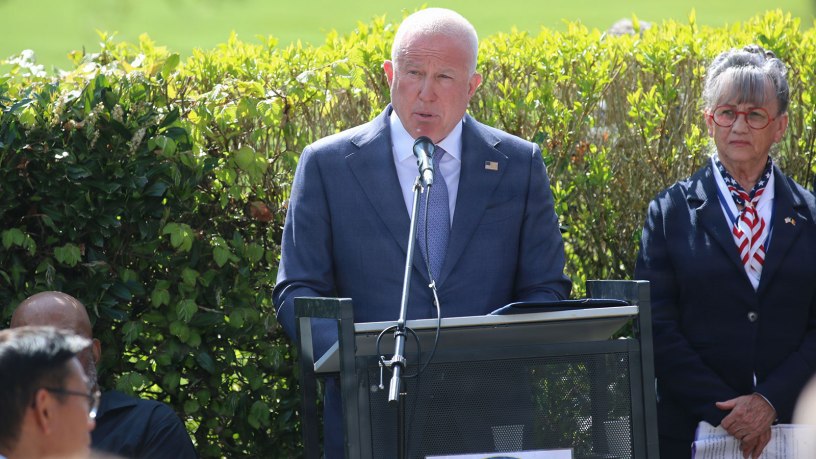
Service members, Department of War civilians, Belgium military members and U.S. and Belgian citizens attended the ceremony alongside distinguished guests including Bill White, U.S. ambassador to Belgium, Erik Wiesemes, mayor of Amel, and Col. Kevin Jackson, 21st Theater Sustainment Command Civil affairs.
“I attended last year while serving as the SHAPE and Brussels Healthcare Facilities commander, and I gladly volunteered to return this year as deputy commander of LRMC,” Douglas said. “For me, this is not simply attendance at a ceremony, it is the continuation of a moral obligation.”
Douglas said Soldiers demonstrated extraordinary courage during one of the hardest moments of World War II while serving in a segregated U.S. Army that did not always recognize their dignity or sacrifice.
“These men were from the segregated 333rd Field Artillery Battalion,” White said. “They grew up under the weight of segregation and still chose to wear the uniform of the country they loved,” said White. “They served valiantly and believed in something greater themselves.”
He said the Soldiers arrived at the Langer family farm seeking food and shelter, and Matthias Langer and his family welcomed them without hesitation.
“In that simple act of courage and compassion the family embodied the very best of humanity,” said White.
Soon after a German SS patrol discovered the Soldiers, captured them and marched them away, before torturing and executing them on December 17, 1944.
“They were captured, beaten, and murdered,” said White. “Not in the heat of battle, but through cold, calculated cruelty.”
The Soldiers’ bodies remained beneath the snow for weeks, before they were recovered. White said the official reports and photographs documented evidence of extreme brutality. Including broken limbs, bayonet wounds and severed fingers.
“This could have been the end of the story, but it was not,” said White. “The Langer family never forgot.”
Patrick Langer, whose father witnessed the aftermath of the killings as a child, said the family dedicated itself to preserving the Soldiers memory.
“My father was 12 years old at the time,”, said Patrick Langer. “He never forgot these Soldiers and devoted his life to ensuring their sacrifice would be remembered.”
The family has been involved with commemorating these Soldiers for the past 80 years. They established the Wereth 11 Memorial in 1994 at the site of the massacre.
And will continue to pass the commemoration down to future generations.
“Seven of the men were buried at Henri-Chapelle American Cemetery in Belgium, White said. “The other four were returned to their families in the United.”
The final resting places of the Soldiers reflect a broader story, one that, for decades, remained largely untold despite the sacrifices these men made during the war.
Douglas said the story of the Wereth 11 remained overlooked for decades because it reflected difficult truths about war, racial segregation and the treatment of Black service members during World War II.
“This story sat at the intersection of several uncomfortable realities,” Douglas said. “The brutality of war, segregation within the U.S. Army, and the fact that Black Soldiers’ contributions were too often excluded from the historical record.”
Acknowledging history Douglas said means recognizing not only the Soldiers’ sacrifice on the battlefield, but also the contradictions they faced while serving their country during a segregated era.
In 2017 Congress formally recognized the 11 African American Soldiers of the 333rd Field Artillery Battalion through House Concurrent Resolution 43, honoring their sacrifice and urging further acknowledgement if their killing, which had been omitted from the 1949 war crimes report.
Douglas said the Soldiers’ legacy requires today’s military leaders to confront the heroism and contradictions of the era.
“These men fought against tyranny and racial hatred while wearing the uniform of a nation that had not yet extended full equality to them within its own military institution,” Douglas said.
He said what stuck him the most was the depth of this community’s fidelity, not as performative remembrance, but as generational stewardship. The Langer family and the Wereth community carried this memory long before any official recognition was made.
Douglas emphasized that preserving military history and honoring the sacrifice of all service members is both a professional responsibility and moral obligation.
“When American service members visit sites like Wereth, Henri-Chapelle, Normandy, and Luxembourg, they are reminded of the legacy they inherit,” Douglas said. “For LRMC, that connection is deeply personal. Our mission is to provide world-class care for service members, families, and allies within this same complex, multinational environment.”
Wiesemes said remembrance ceremonies remain essential to preserving historical memory and educating future generations.
“We must ensure history is never forgotten and continue learning from it,” Wiesemes said.
Retired Sgt. Maj. Charles Hancock, from Sierra Vista, Arizona, said the Wereth 11 did not die in vain and the tragedy of Dec. 17, 1944, must never be forgotten.
My mission over the last four years has been not only to honor the sacrifice, but to educate more Americans about their service and this tragedy,” said Hancock.
Douglas said the Soldiers should be remembered not only solely for how they died, but for how they served.
”These men deserve to be remembered because of their courage, service and sacrifice,” Douglas said. “Representing LRMC and the U.S. Army at this ceremony is an honor.”

