
By Samuel King Jr., 96th Test Wing
EGLIN AIR FORCE BASE, Fla. – What if every medical Airmen could deploy and respond to emergencies including natural disasters and battlefield threats, regardless of their medical specialty?
Air Force Medical Command proposed the question and the 96th Medical Group recently tested the concept.
The Aug. 18-20 exercise evaluated the Air Force Medical All Hazards Support concept of operations, equipment requirements, and overall training effectiveness. AFMEDCOM exercise evaluators will use results and feedback from the Eglin exercise to finalize the concept of operations and modernize the Air Force medical response posture.
“This initiative transitions the legacy Home-Station Medical Response rigid framework, to a flexible and scalable capability that can rapidly deploy in expeditionary and in-garrison.” said Mr. Brian Smith, Air Force Medical Command’s AF Medical Expeditionary and Homeland Response director of operations.
Joe Archangel, 96th MDG training specialist, and Karl Day, 96th MDG medical emergency manager, developed the training curriculum to evaluate the medics who tested the new concept. Their program focused on equipping Air Force medics, including support personnel, with advanced skills blending tactical combat casualty care and chemical, biological, radiological, nuclear, and explosive response.
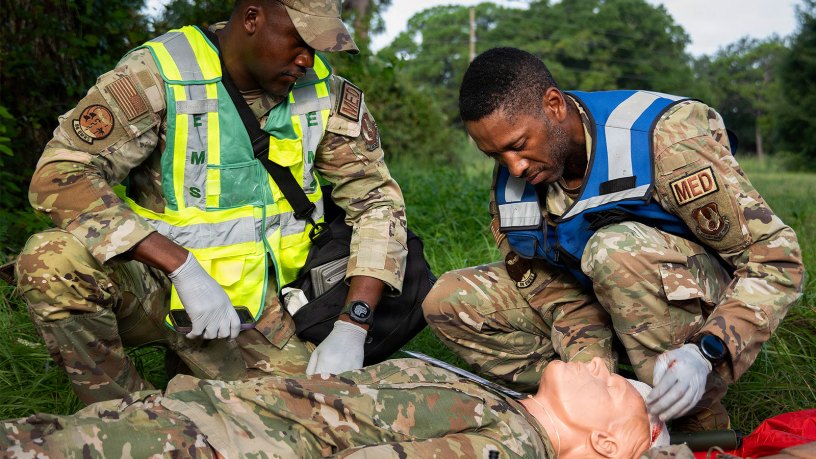
During the exercise the Airmen received the necessary training and then executed their skills during two distinct high-stress field scenarios.
Phase I (in garrison, base-level attack): As first responders, medics and non-clinical hospital personnel treated trauma casualties exposed to a chemical agent, managing on-scene triage, stabilization, and decontamination, in response to a simulated base attack.
Phase II (expeditionary, contested CBRN environment): Medics and non-medical hospital personnel operated in a contested area, executing decontamination procedures, managing patient care, and transitioning through CBRN zones.
During the capstone events, the medics successfully demonstrated the scalability of the higher-level medical training protocols seamlessly into TCCC/(MARCHE)2 with CBRN patient management.
“Our team was specifically selected to help shape the future inpatient platform concept of operations by executing and validating this proof-of-concept exercise at Eglin AFB,” Day said. “This is important because we are helping shape how the Air Force will respond to garrison and expeditionary threats.”
 That PAO Guy