
By Spc. Seu Chan, 3rd Special Forces Group (Airborne)
FORT BRAGG, N.C. — In the U.S. Army, chaplains play a unique role in providing moral, religious and spiritual support to the formation. In 1864, the First Geneva Convention established the foundation for chaplains’ noncombatant status, preventing them from carrying weapons or engaging in direct combat. Today, their noncombatant status is governed by Department of War and Army policies and regulations. This creates unique requirements for religious affairs specialists (56M), whose doctrinal role is to perform and coordinate the necessary force protection required for chaplains to conduct religious activities.
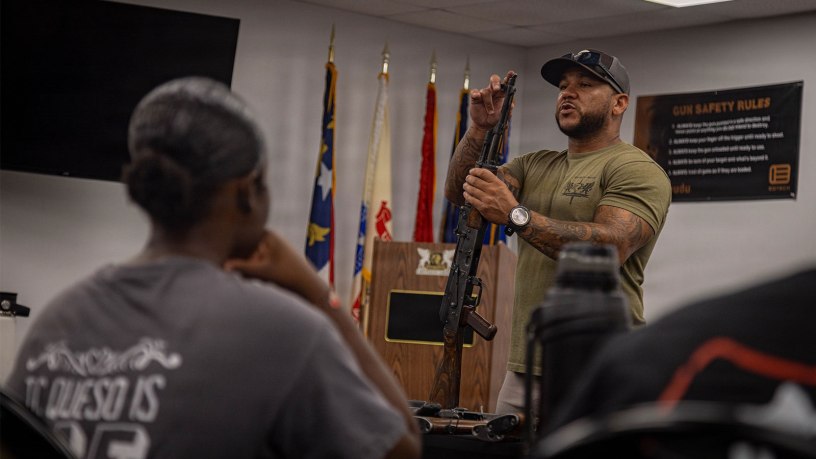
To prepare 56Ms for the unique challenges they may face in austere environments, 3rd Special Forces Group (Airborne) implemented a two-week Single Asset Protection Program, tailored to building operational readiness among the unit’s 56Ms. The program was designed to teach Soldiers the principles of force protection, basic handgun marksmanship, defensive driving techniques and foreign weapons training so that they can be prepared for the unique challenges Special Operations units face in hostile environments.
“Just like every Soldier, 56Ms need to have baseline proficiencies in their tactical skill set,” said U.S. Army Chaplain (Maj.) Adam Langley, 3rd Group’s chaplain. “Our force protection model is designed so that we can sharpen that razor’s edge of tactical proficiency.”
The two-week training program began at the indoor Baffle Range on Fort Bragg, a specialized range designed to execute live-fire training in a controlled environment. There, Soldiers trained for five days with a Green Beret instructor, familiarizing themselves with handguns and building tactical confidence. During this phase of training, Soldiers refined their skills through single-target shooting drills before transitioning to more complex exercises involving multiple targets and effective reloading techniques. The training prepared them for a follow-on week focused on high-stress, real-world combat scenarios.
“Prior to this training, some of our 56Ms had very limited experience with handguns,” said U.S. Army Staff Sgt. Jacob Snowden, 3rd Group’s Unit Ministry Team noncommissioned officer. “It is important to get the Soldiers familiarized with the fundamentals before we transition into more tactically demanding drills in the second half of training.”
After building a foundation of fundamentals, the second week of the program shifted focus from building individual proficiency and confidence, to placing Soldiers in high-stress situations they may encounter while in deployed environments. The training included react-to-contact drills, defensive and off-road driving, vehicle recovery drills and providing asset protection both individually and in a team.
The program also pushed Soldiers beyond the conventional scope of duties often expected of 56Ms, exposing them to equipment and weapon systems they don’t regularly encounter during home-station training. Soldiers trained on manual and right-hand-drive vehicles and familiarized themselves with foreign weapon systems, including AK-47s, MP5s, PKMs and RPGs, broadening their ability to operate alongside their UMTs in unfamiliar environments.
“UMTs supporting Special Operations often work alone and unafraid in a variety of complex and austere settings,” said Langley when asked why this training was important. “Thus, 56Ms require specialized force protection capabilities to ensure not only the safety of the UMT but the successful completion of the Religious Support mission.”
Recognizing the value of this training to the unit’s operational readiness, 3rd Group’s UMT developed the program to enhance readiness, increase lethality and invest in the formation. “Standardizing this training for every religious affairs specialist is necessary in order to train and equip our 56Ms across the force on how to provide adequate single asset protection to their UMTs so they can get in and out of the country safely with little to no risk,” Snowden said.

